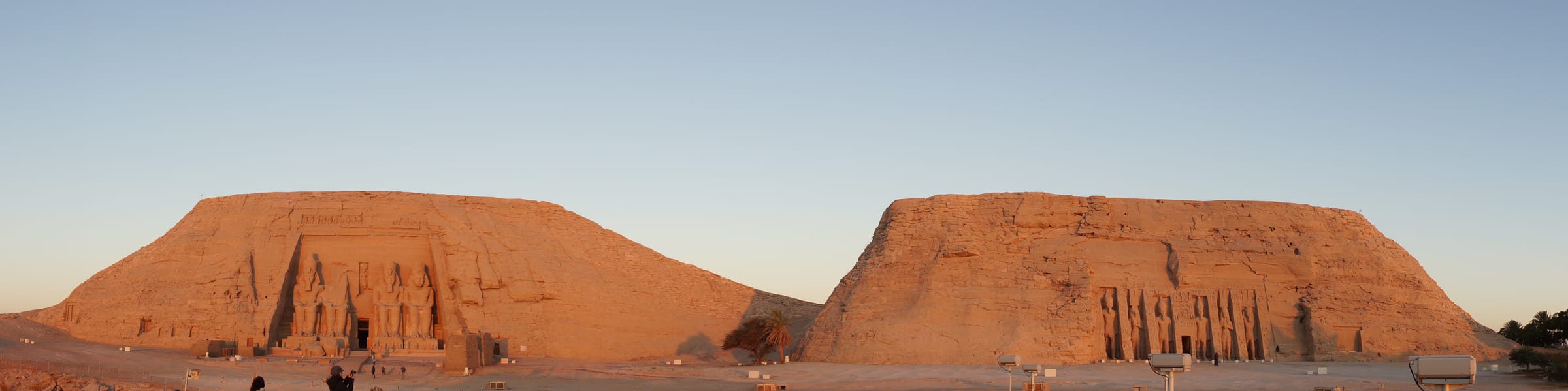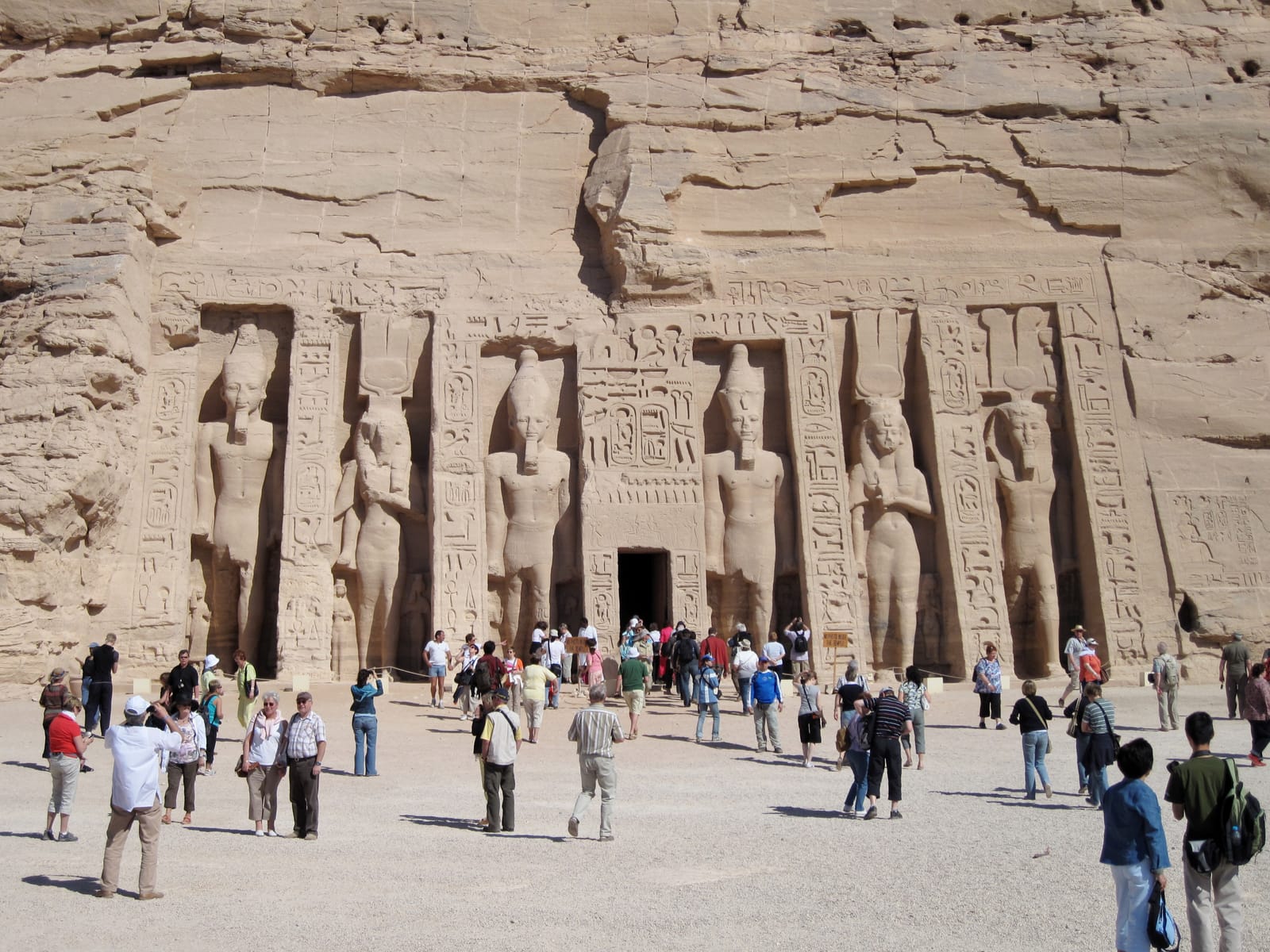
A hundred metres north of the Great Temple, and easy to rush past, stands the monument that most visitors end up preferring. The Temple of Hathor and Nefertari — the Small Temple — has six standing figures about 10 metres tall on its facade: four of Ramesses, and two of his queen. Nefertari is carved the same height as her husband, which in Egyptian royal art is close to unheard of. Queens were usually knee-high.
The dedication inscription is unusually personal: the temple was built "for the Great Royal Wife Nefertari, for whose sake the very sun does rise". Inside, square pillars are topped with the face of Hathor, the goddess of love, music and joy, and the reliefs are gentler than next door — offerings, crowns, the queen shaking sistra. After the imperial thunder of the Great Temple, it feels like a different civilisation.
Top things to do at Temple of Hathor & Nefertari
Compare the two queens on the facade
Nefertari stands between colossi of Ramesses, flanked by small figures of their children. Look at the height: she is his equal in stone, and Egyptologists still argue about how far to read that politically.
Look up at the Hathor pillars
Six square pillars carry the goddess’s face — human features, cow ears, a heavy wig. They are the softest carving at Abu Simbel and photograph beautifully in the low interior light.
Find the queen making offerings
On the side walls Nefertari appears offering to Hathor and Mut in her own right, rather than merely standing behind the king. It is a small detail that says a great deal.
Stand in the sanctuary
At the far end, a statue of Hathor as a cow emerges from the rock, with a small figure of Ramesses under her chin. It is one of the strangest and most affecting images in Egyptian art.
How to get to Temple of Hathor & Nefertari
- The Small Temple shares the same site, ticket and entrance as the Great Temple — it is a two-minute walk north along the terrace.
- Every organised Abu Simbel tour includes it, but not every guide gives it much time. If you care, say so at the start of the visit.
- From Aswan, the same road and flight options apply as for the Great Temple: about 3 to 3.5 hours by car, or 45 minutes by air.
- Go here first if you arrive with a crowd. Most groups start at the Great Temple, so the Small Temple is often almost empty for the first half-hour.
- The interior is darker and smaller than its neighbour; give your eyes a minute to adjust before deciding there is nothing to see.
- The same photo ticket covers both temples — no need to buy twice.
Best tours & tickets for Temple of Hathor & Nefertari
These top-rated experiences are the easiest way to see Temple of Hathor & Nefertari:
 Private day tour from $166
 Aswan: Abu Simbel Temple & Nubian Village Private Day Tour
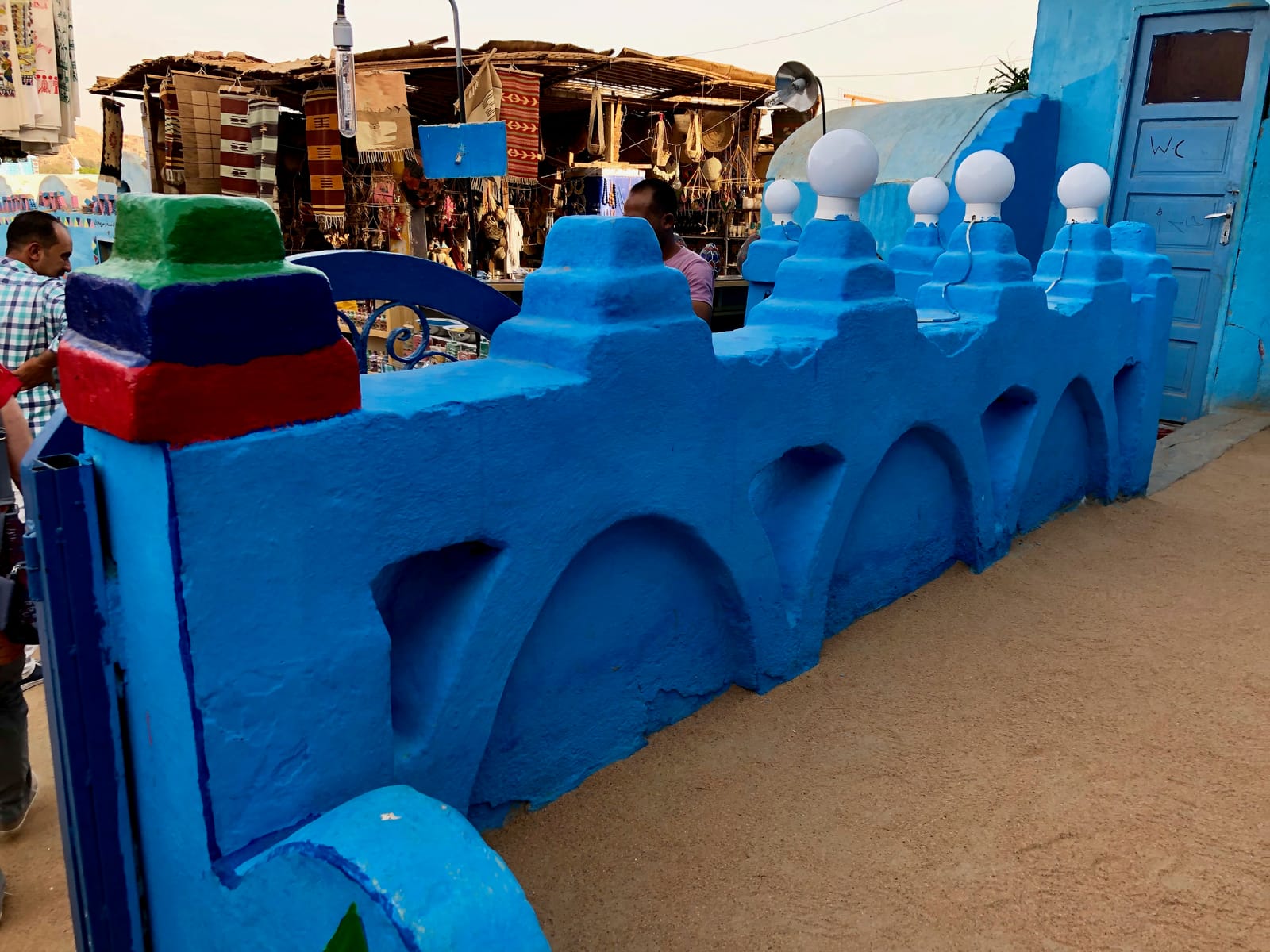
The best-value way to understand Abu Simbel as more than a monument. The morning is the temples; the afternoon is Nubia — the villages of vivid blue and ochre houses whose people were displaced when Lake Nasser filled, the same flood that forced the temples to be moved. Seeing both in one day turns the rescue story from an engineering anecdote into something human. Small operator, private guide, consistently strong reviews.
- Abu Simbel’s two temples plus a Nubian village visit
- Meet the community whose homeland the reservoir flooded
- Private guide, private vehicle, skip-the-line entry
 Flight day trip from $135
 Aswan: Abu Simbel & Nefertari Temples Express Tour by Air
If your Egypt itinerary is tight, flying is the answer. EgyptAir’s short hop from Aswan lands you 15 minutes from the temple gate, so the entire excursion fits into a morning — and the descent over Lake Nasser, with the two temples appearing as pale scars in the sandstone, is worth the fare on its own. You still get a guided visit to both temples; you simply skip six hours in a van.
- Return flight Aswan–Abu Simbel — 45 minutes each way
- Whole trip done in about 6 hours instead of 10–11
- Both the Great Temple and the Temple of Hathor